|
January 23, 2026, 2026 | 5 Shevat 5786 | Candle lighting at 4:37 p.m.
|
|
|
This message has approximately 883 words and will take about 3 minutes to read.
|
|
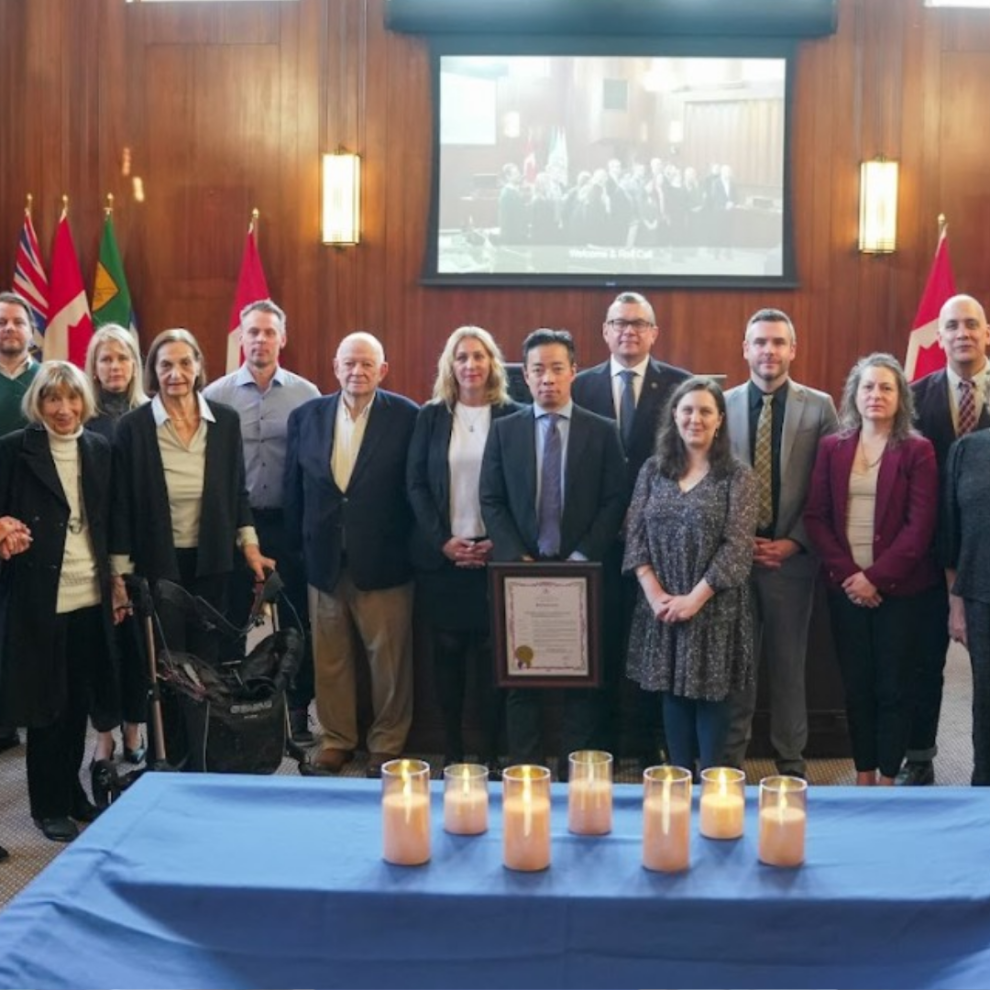
| Earlier this week, the Vancouver City Council once again recognized January 27 as International Holocaust Remembrance Day (IHRD). |
|
| I had the immense honour of joining the Vancouver Holocaust Education Centre (VHEC) and the Centre for Israel and Jewish Affairs (CIJA) to speak at the City Hall, and to listen as survivor Miriam Dattel shared her story and reflections. |
|
|
| That recognition extends beyond the council chamber: the City’s IHRD page reminds us that commemoration and education are shared civic responsibilities, something our whole community can lean into together. On January 27, City Hall will be illuminated yellow; a colour chosen to evoke the memorial candles lit in remembrance of all victims of the Shoah, an integral symbol within Holocaust commemorations. |
|
| Looking ahead, all are invited to a meaningful IHRD commemoration in Richmond on Tuesday, January 27, at 7:00 p.m., co‑presented by The Bayit and VHEC at The Bayit Synagogue (10791 No. 3 Rd.), featuring a keynote address by a Holocaust survivor, Mariette Doduck. Learn more here. |
|
|
| Makerspace Learning At RJDS
The Richmond Jewish Day School (RJDS) recently hosted a joyful STEAM‑J Night.
|
|
| "The heart of the evening was student voices: kids from Kindergarten to Grade 7 led their families through hands‑on, interactive learning that connected innovation, creativity, and Jewish values", said Sabrina Bhojani, principal at the RJDS. They showcased projects, confidently explained their thinking, and demonstrated how STEAM (science, technology, engineering, arts, and math) intersects with Judaism. |
|
|
| What made this year distinctive is how deeply students drew on the school’s new Makerspace, created with support from the Jewish Community Foundation. The space, complete with 3‑D printers and engineering materials, has become a launchpad for design and experimentation. Many of the projects on display grew directly out of that room, showing how a smart investment can widen both the scope and the quality of learning. |
|
| Just as important, students made explicit links between STEAM concepts and Jewish values: tikkun olam (repairing the world), bal tashchit (responsible use of resources), and communal responsibility. Sharing their work in a Jewish educational setting strengthened a sense of belonging and identity, exactly the kind of learning we’re proud to champion alongside RJDS. |
|
|
Tel Hai Becomes the University of Kiryat Shmona
When we talk about impact, this is exactly what we mean. Because of years of steady Canadian partnership, led by the Jewish Federations of Canada‑UIA (JFC‑UIA) together with local Federations and generous donors, Tel‑Hai Academic College’s long‑held vision is becoming a reality. |
|
| JFC‑UIA and Federations across the country collectively helped move this forward with significant support for Israel’s North, including approximately $25 million CAD toward strengthening the region and advancing Tel‑Hai’s growth. |
|
|
| And now there’s milestone news to share: Israel’s Council for Higher Education has approved the transformation of Tel‑Hai Academic College into the University of Kiryat Shmona, with university recognition beginning in the 2026–27 academic year. The plan includes a ₪570 million (NIS) (nearly $200M CAD) investment over five years; proposals for new Ph.D. programs in biotechnology, education, psychology, and nutritional sciences; a faculty of engineering focused on precision agriculture, knowledge engineering, and AI; and a veterinary school in the Golan Heights. |
|
| Just as important, the university is designed to be woven into the life of Kiryat Shmona itself, integrating with the city to attract students and faculty, create jobs, and serve as a lever for regional renewal. eJewish Philanthropy spoke with Sarah Mali, director general of JFC-UIA's Israel office. Read more here. |
|
|
| Witness To Munich: The Karen James Story
The stories we carry forward shape how the next generation understands responsibility. Karen is someone many of us know not only as an Olympian, but as a mentor, volunteer leader, and friend. As a member of Team Canada at the 1972 Munich Olympics, she witnessed the moments surrounding the terror attack that claimed the lives of 11 Israeli athletes and coaches, an experience she later chose to share publicly, helping communities across North America reckon with history through the power of testimony.
|
|
| That journey is at the heart of Witness to Munich: The Karen James Story, premiering Sunday, February 8, 2026, at 1:00 p.m. ET (10:00 a.m. PT) at the International Jewish Sports Hall of Fame, followed by a live Q&A with Karen. The film is a story of memory and bearing witness, and the trailer and preview clips capture its tone beautifully. Register here. |
|
|
| If you can’t attend the event, watch it on the Hall of Fame’s YouTube channel afterward.
Karen’s leadership extends well beyond the pool and the screen. She has held senior volunteer roles within our Federation and remains active nationally through CIJA, bringing the same clarity and purpose to advocacy and communal life that she brings to sharing her story. She is, quite simply, a deeply respected and much‑loved leader in our community.
|
|
Ezra S. Shanken
CEO, Jewish Federation of Greater Vancouver |
|
 |
| RSVP for the upcoming Wexner Speaker Series with Aaron Katler. |
 |
| February kicks off with more sessions for newcomers. Learn more here. |
|
| Kalman & Leopold – Surviving Mengele’s Auschwitz is the harrowing firsthand account of how two boys survived humanity’s darkest hour. As narrated to Richard K. Lowy, Leopold’s son, this extraordinary memoir delivers the raw truth from inside the Nazi killing machine with the intensity of a masterful thriller. Learn more here. |
|
|
| It is the summer of 1941, and Malka is ten years old. Her small town of Romanov, Ukraine, has just been occupied by the Nazis, and Malka’s Jewish traditions, culture, and community are under attack. Malka and her mother manage to escape. As Malka relies on her faith and instincts to keep herself and her mother alive, she finds refuge with strangers who become like family along the way. Learn more here. |
|
|
|