|
April 1, 2026 | 14 Nissan 5786 | Candle lighting at 7:26 p.m.
|
|
|
This message has approximately 870 words and will take about 3 minutes to read.
|
|
|
Passover is a time I hold close, especially the Seder I share with my family and friends, and I wanted to share these reflections a bit earlier as we approach the holiday. Gathering around the table with Rachel, our three children, and loved ones creates moments of genuine connection through stories, questions, and time spent together with intention.
As the Seder progresses, we retell the story of our ancestors’ escape from slavery in Egypt, a story that has been carried forward for generations around tables much like our own. For me, moving between discussions and ritual makes the meaning of the story feel immediate and real. It’s not only about remembering the past, but about what that history asks of us today: the freedom to live openly and proudly as Jews, to pass our traditions to the next generation, and to stand firmly in who we are.
This year, those themes feel especially powerful in light of the rise in antisemitism and the ongoing pain surrounding the war in Israel. Retelling a story of resilience and survival is a reminder that our strength has always come from one another. It reinforces the importance of empathy, solidarity, and care, values that sustain us not only during Passover but throughout the year.
|
|
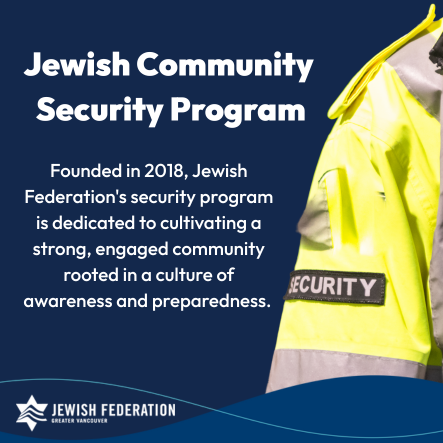
| That same sense of care and responsibility is reflected in the security work we continue to prioritize as a community. In line with our tradition before Passover, we have a community security update from Jason Murray, chair of our Community Security Advisory Committee. |
|
|
|
As Passover approaches and we ready our homes for the seder, we are reminded that study and action have always been central to our tradition. Consider how study and action might inform how we commit to securing our community: training, situational awareness, and community coordination that help us understand our security environment, support our institutions, and respond effectively when concerns arise.
Jewish communities across Canada and abroad face a deeply challenging security environment. Federal intelligence assessments have warned of a realistic possibility of extremist violence targeting Jewish Canadians, alongside a rise in harassment, intimidation, and vandalism directed at Jewish institutions. We have witnessed troubling incidents internationally and at home, including the violent attack at a Michigan synagogue, the Bondi Beach massacre, Toronto synagogues hit with gunfire, and countless other acts of antisemitic hostility. Taken together, these developments reinforce a difficult truth: maintaining a secure and resilient community requires steady attention and a shared commitment to preparedness.
|
|
| Over the past decade, our Federation has steadily developed a community security program, focusing on thoughtful planning, practical training, and partnerships across the community. What began as a local initiative is evolving into a broader network through collaboration with community security hubs in Montreal, Toronto, and communities across Western Canada. |
|
|
| This work is supported by strong relationships with law enforcement agencies and, recently, by a meaningful commitment from the federal government to enhance security funding for Jewish institutions and a provincial proposal to extend “access zone” protections around places of worship where specified forms of harmful behaviour would be prohibited.
Our security professionals collaborate with schools, synagogues, community centres, camps, and other partners to assess risks, strengthen infrastructure, and develop emergency protocols. Over the last week, our Federation delivered community security webinars to share practical guidance on situational awareness and preparedness, reinforcing that effective security depends not only on physical measures, but on people. Our greatest strength continues to be a community that stays attentive, informed, and ready to look out for one another.
|
|
| Our Bitachon volunteers embody an approach that stresses action, offering a visible presence at gatherings throughout the year. Their efforts, combined with the expertise of our security team, and coordinated with local law enforcement, help better ensure that our institutions remain safe, welcoming places. |
|
|
|
All of this work requires sustained investment, and the financial demands of effective community security remain significant. Government support is essential, but it is our community’s generosity that enables the day‑to‑day efforts that keep us safe.
I invite you to take part in security awareness opportunities available throughout our community and to remain attentive to your surroundings. I likewise encourage you to continue engaging with and supporting our Federation, whose work strengthens the safety and resilience of our entire community.
|
|
| Remember that resilience depends on each of us taking simple but meaningful steps. If something does not look or feel right, trust your instincts. See something, say something, do something.
In an emergency, call 9‑1‑1 immediately. For non‑urgent concerns, contact local police and then inform our security team.
|
|
|
| Wishing you and your families a chag Pesach kasher v’same’ach. |
|
| Building on the security update above, I'd like to remind you to take an important step for our community's safety. In partnership with JReady, we've launched a structured emergency preparedness process for Jewish communities in British Columbia, starting with a survey to assess our readiness. If you haven't yet, please take a moment to complete the survey. Your input is vital for shaping our future efforts. Click here to participate. |
|
|
Please note that our office will be closed on Thursday, April 2 and Friday, April 3, for Passover. Wishing you and your loved ones a meaningful and memorable seder.
Shabbat shalom and Chag Pesach sameach,
|
|
Ezra S. Shanken
CEO, Jewish Federation of Greater Vancouver |
|
 |
| Join JACS for a unique Seder-like dinner and discussion. Register here. |
|
| As Passover approaches, Dan Senor speaks with Rachel Goldberg-Polin about how this year’s Seder lands differently. In a moment shaped by war, loss, and uneasy relief, they explore how the rituals of Passover hold both joy and sorrow—and why that tension is the point. Less about retelling the past, this conversation asks what it means to be free right now. |
|
|
| What the Jews need now is a really good Passover Seder. At this time of division and vulnerability, the Seder can recharge our sense of belonging and rootedness – all it takes is a pillow, a cup, some anxiety, and green onions. Read Mishael Zion's blog here. |
|
|
|