There is a tension in the fight against antisemitism that those of us in this work live with every day.
On one hand, much of what we do must be disciplined, strategic, and data driven. Over the past number of years, we have invested heavily in understanding the problem through polling, research, and community insight. We track trends, measure impact, and build tools based on evidence.
And yet, sometimes, the most important things we do come from somewhere else entirely.
They come from moments in time and from the heart.
Our World Cup campaign in partnership with JewBelong is one of those moments. And it is important to say that this was not only an organizational decision. It was a leadership one. Our Chair of the Board, Lana Marks Pulver, helped drive this as a heart based endeavor, recognizing that alongside strategy and data, there are moments that call for courage, instinct, and a willingness to act.
JewBelong itself was born from a simple but powerful idea: that Jewish identity should be visible, proud, and accessible, and that fighting antisemitism requires speaking in a language that reaches beyond the Jewish community. Known for its bold pink billboards across the United States, JewBelong has built a platform that is clear, direct, and unapologetic.
Bringing that approach to Vancouver, at a moment when the world is watching, felt both natural and necessary. JewBelong understands something important about modern antisemitism. Facts matter. Research matters. But before people will engage with a problem, they first have to notice it. Visibility matters too.
As Vancouver hosts the world, as global attention turns toward a game that transcends borders and unites people across cultures, we saw an opportunity. Not one that emerged from a report or a dashboard, but one that presented itself clearly.
A moment to speak.
A moment to interrupt.
A moment to say that while the world is watching the beauty of the game, there is something deeply broken off the field that cannot be ignored.
Antisemitism is not a local issue. It is a global phenomenon. And when the world comes to our city, we have a responsibility not only to welcome it, but to engage it.
So we acted.
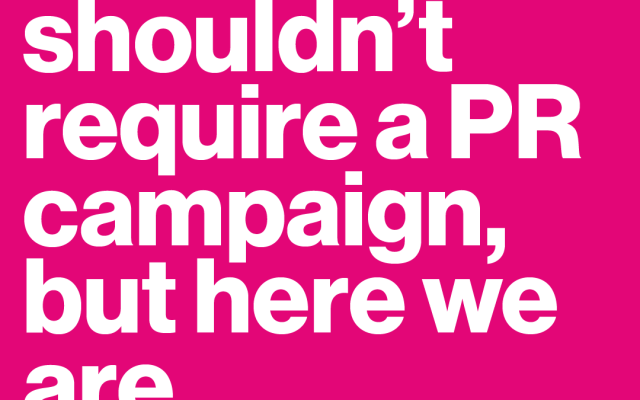
We blanketed the region with bold pink signs across transit lines, major corridors, and the everyday paths of hundreds of thousands of people. At the same time, we placed those same messages into the hands of thought leaders and decision makers.
And I keep coming back to a simple question.
Can a pink sign really make a difference?
On its own, no.
But that is not the point.
Because the moment we are in does not call for this or that. It calls for this and that.
Strategy and heart. Data and instinct. Long term planning and seizing the moment in front of us.
Too often, we convince ourselves that if something is not comprehensive, it is not worthwhile. That if it does not solve the whole problem, it is not worth doing at all.
But that thinking is precisely what holds us back.
A pink sign is not the solution.
But it is a spark.
It disrupts. It interrupts. It creates a pause in someone’s day. It plants a thought and opens a conversation that might not have happened otherwise.
And once that door is open, anything is possible.
I am reminded of a story about a young child walking along a beach covered in starfish. One by one, the child picks them up and throws them back into the ocean. An adult looks at the vast shoreline and says, “You cannot possibly save them all. What difference does it make?”
The child throws one more starfish into the water and replies, “It made a difference to that one.”
In recent weeks, I have found myself saying to our team: be the child, not the adult. In a sea of people overwhelmed by the scale of the problem, choose to act anyway.
Because that is how change happens.
Not all at once.
But one person at a time. One moment at a time.
As the games begin and global attention turns toward Vancouver, our own work takes on renewed urgency: ensuring that antisemitism is not ignored simply because the world is focused elsewhere.
But our opponent is not hate alone.
It is indifference.
Because hate does not grow in isolation. It grows when people look away. When they choose silence over discomfort. When they decide something is not their responsibility.
And so part of this work is not only about confronting antisemitism directly. It is about challenging indifference wherever it lives.
It is also about something just as important.
Sometimes, we act not only to change the world around us, but to remind our own community that we are not standing still. That we are not accepting this reality. That we are, and will always be, in this fight.
Here in Canada, we sit at the top of a deeply unenviable reality, shaped by the tsunami of antisemitism that has surged since October 7. The numbers tell a chilling story. But behind those numbers are people asking whether they are alone, whether anyone sees what they are experiencing, whether anything is being done.
And sometimes, even something as simple as a bright pink sign can answer that question.
Not because it solves the problem.
But because it says something powerful.
You are seen.
You are not alone.
We are not standing by.
Maybe it also says something even more fundamental.
That we will not go quietly into the night.
When the world comes to Vancouver and British Columbia, one could be forgiven for being blinded by its beauty. I have been here for twelve years, and there are still moments when my breath is taken away.
But true beauty is not only found in the mountains, the ocean, or the gleaming glass towers.
It is found in how we treat one another.
My grandfather, Rabbi Sidney Shanken of blessed memory, used to say that the beauty of Judaism is that the same God who created the universe also cares deeply about how one person treats another.
That idea stays with me.
Because it reminds us that even in a world of vastness and grandeur, it is the smallest human interactions that define who we are.
At bridge crossings, in downtown cores, in neighborhoods, on trains and in stations, those pink signs are creating presence. They are pushing back against silence. They are competing with indifference on one of the world’s biggest stages.
And yes, measured against the scale of the problem, it can feel small.
Which brings me back to the image that continues to guide me.
At the end of the day, we are the child walking along the beach.
And when others say, “What difference can it make?”
We answer differently.
We saved that one.