This past weekend, while Vancouver celebrated Pride, I found myself thinking less about the parade and more about the people I am privileged to work alongside every day.
For years, and especially since October 7, we at Jewish Federation of British Columbia have heard from queer Jewish community members grappling with a painful reality. People who once felt entirely at home in Pride spaces no longer felt certain they could show up as their full selves. Some worried about displaying a Magen David. Others worried about expressing their connection to Israel. Many spoke about feeling increasingly isolated in communities where they had once experienced unquestioned acceptance.
These were not isolated conversations. We heard them repeatedly. In one on one meetings. At community events. In private conversations. And increasingly from people who felt trapped between identities that had never before been in conflict.
Earlier this year, research from Jewish Federations of North America found that LGBTQ+ Jews are seeking more than inclusion. They are seeking belonging. They are looking for communities where they do not have to choose between different parts of their identity. Reading those findings, I immediately recognized the conversations we have been having in British Columbia for years, and especially since October 7.
By the time Pride arrived this summer, it had become impossible to ignore what many queer Jews were telling us: being invited to participate is not the same thing as feeling safe enough to do so.
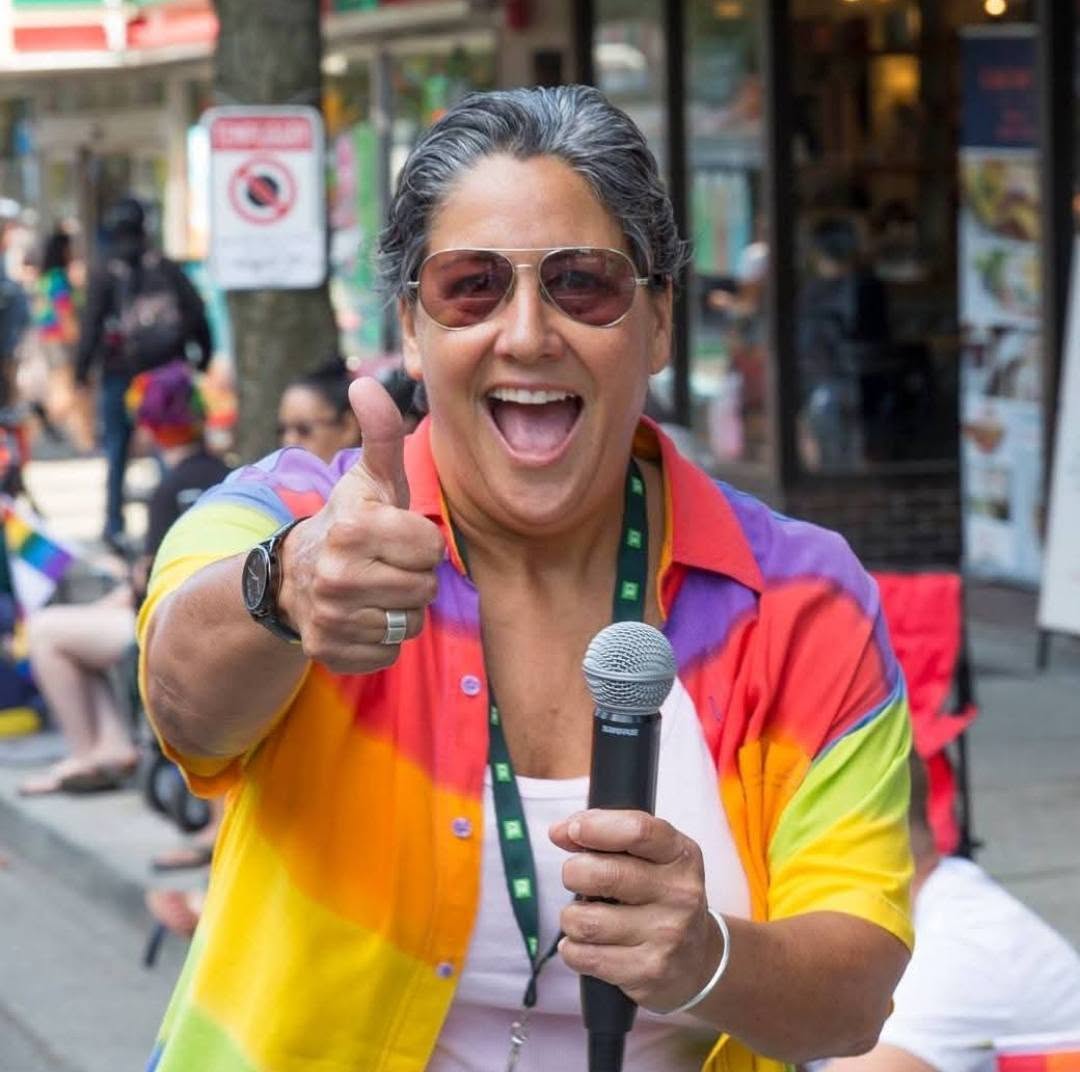
At the center of this story is my colleague, Caryl Dolinko, our Director of Communications and Marketing at Jewish Federation of British Columbia.
I could not be prouder of her.
Caryl did not simply help create our campaign. She helped build Pride itself. Before joining our team, she served as Director of Communications and Sponsorship for the Vancouver Pride Society, emceed the Vancouver Pride Parade for nearly a decade, and held senior leadership positions with InterPride, the International Association of Pride Organizers.
Her essay, I Helped Build Pride. Now I Don’t Belong, published this week in the Canadian Jewish News, is one of the most honest and courageous pieces I have read in a long time.
She writes not with anger, but with heartbreak. Not as an outsider criticizing Pride, but as someone who devoted years of her life to helping create it.
What struck me most about her essay was not anger.
It was sadness.
Here is someone who spent decades building a movement dedicated to authenticity and inclusion, only to question whether she can fully belong within it.
And she is not alone.
Sometimes it feels as though being queer is not enough when you’re also Jewish.
Not because queer Jews are any less queer.
But because some have come to feel that acceptance extends only to the parts of their identity that make others comfortable.
They can be queer, but not too Jewish.
The message is rarely explicit.
But it is felt.
And that should concern everyone who believes in inclusion.
Queer Jewish thinker Rabbi Jay Michaelson has spent years exploring the tension that emerges when belonging becomes conditional. The problem is not disagreement. Healthy communities can survive disagreement. The problem begins when people feel compelled to suppress part of who they are in order to remain welcome.
That is the challenge many queer Jews have been describing.
As a Federation, we exist to convene community. Our role is not to speak for people. Our role is to listen to them, bring them together, and help ensure their voices are heard.
This campaign emerged from exactly that process.
It was shaped by years of conversations with queer Jewish community members.
It was brought to life through the creativity and determination of Caryl and our team at Federation.
It was strengthened through our partnership with the Centre for Israel and Jewish Affairs.
And it was embraced by Jewish organizations and leaders across our community who immediately understood why this mattered.
No single organization created this effort.
It was a communal response to a communal challenge.
At a conference table in our office, our team began discussing what to do. We had pursued dialogue. We had listened. We had worked hard to reassure people who simply wanted to belong. But ultimately we were faced with a simple reality: if some queer Jews no longer felt safe enough to march openly as Jews, how could we ensure their voices were still heard?
Together, we came to a simple conclusion.
Absence would not mean silence.
A digital truck would move through the parade carrying messages that should never have been controversial:
“Jewish. Queer. Proud.”
“Diversity Includes Jews.”
“No one should have to choose between celebrating Pride and feeling safe.”
The messages were simple because the principle is simple.
Nobody should be asked to choose between parts of their identity.
Nobody should have to hide who they are in order to belong.
As the truck moved through the parade route, something remarkable happened. People stopped. They read. They took photographs. They talked. Many had never considered the experience of queer Jews.
That was the point.
Not to provoke.
To be seen.
Which brings me to a broader reflection.
Let Pride be Pride.
Pride was never meant to solve every conflict in the world. It was never intended to become a vessel into which every global grievance, political cause, or ideological litmus test is poured. Its purpose was both simpler and more profound: to create a space where people could live openly, authentically, and safely as themselves.
When Pride becomes everything that is ailing our world, it risks ceasing to be Pride.
The more issues it attempts to carry, the easier it becomes to lose sight of the people it was created to serve.
The measure of success should be simple.
Can people show up as their whole selves?
If a Jewish lesbian who devoted decades to building Pride wonders whether she truly belongs, then that question deserves an honest answer. If queer Jews feel they must edit, conceal, or explain parts of themselves in order to participate, something important has been lost.
Pride succeeds when the tent gets bigger.
It falters when belonging becomes conditional.
What gives me hope is people like Caryl Dolinko.
Despite everything she describes in her powerful essay in the Canadian Jewish News, she has not walked away. She still believes in Pride. She still believes in belonging. She still believes there is room for everyone under the tent.
So do I.
My pride this year was not in a parade.
It was in our people.
In Caryl’s courage.
In the partnership between Jewish Federation, CIJA, and the many Jewish organizations that stood together to ensure queer Jewish voices would not disappear.
In the queer Jews who have trusted us with their stories, especially since October 7.
And in the belief that nobody should ever be asked to check part of their identity at the door.
Let Pride be Pride.
Let it remain a place where people can bring their whole selves.
Pride was born from the belief that people should never have to hide who they are. My hope for next year is simple: that queer Jews return to Pride not because they changed who they are, but because Pride once again makes room for all of who they are.